Not rendering correctly? View this email as a web page here.


July 13, 2018

Brookings on Twitter Brookings on Facebook
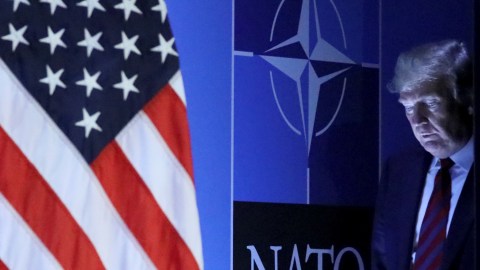
U.S. President Donald Trump arrives to hold a news conference after participating in the NATO Summit in Brussels, Belgium July 12, 2018. REUTERS/Reinhard Krause - RC14C0578050
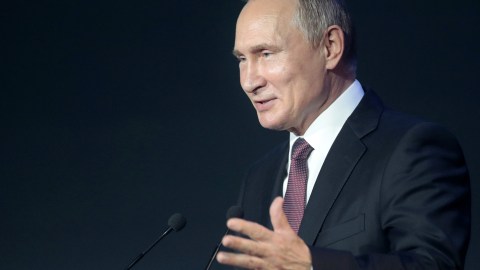
Russia's President Vladimir Putin delivers a speech as he attends the International Cybersecurity Congress in Moscow, Russia July 6, 2018. Sergei Chirikov/Pool via REUTERS - RC1FFDC47C00
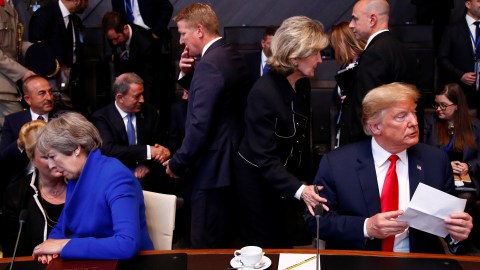
Britain's Prime Minister Theresa May  and U.S. President Donald Trump attend a meeting of the North Atlantic Council during a NATO summit in Brussels, Belgium July 11, 2018. REUTERS/Francois Lenoir - RC12B187B3E0

Featured quote

[Trump's] remarks were essentially a bombshell that went off and caused NATO officials to scramble to interpret what he meant."

July 12, 2018 | Amanda Sloat, The Washington Post

REGIONAL AND TOPIC UPDATES

Europe

NATO burden-sharing. Michael O'Hanlon explains that stationing U.S. troops in Europe is far less costly than President Trump implies when he pushes European allies to spend more on their common defense. Separately, Jeremy Shapiro argues that Trump's demand that NATO allies increase their defense budgets is a roundabout attempt to reduce the U.S. trade deficit with Europe.

NATO and democracy. While NATO faces significant security challenges around the world, Norman Eisen and James Kirchick argue that the alliance must also address threats to democracy among its own members. Meanwhile, Jonathan Katz and Torrey Taussig highlight three security-related reasons why combating democratic backsliding should be a priority for the alliance.

What Trump gets wrong. Constanze Stelzenmüller writes that although some of President Trump's criticisms of NATO and Europe are correct, he is wrong in his contempt for representative democracy, open societies, and a rules-based international order, and his admiration for autocrats and dictators.

The growing divide in the alliance. Trump's consistent berating of NATO allies may indeed spur higher defense spending, but the "America First" outlook is sacrificing U.S. influence and power in the long run, writes Will Moreland.

Future NATO summits. Pointing to the “unnecessary drama” around this week’s NATO meeting, Derek Chollet and Amanda Sloat argue that the alliance may be better served by leaving the work to the foreign and defense ministers, who already each meet three times a year.

A new framework for European security. In his recent book, "Beyond NATO," Michael O'Hanlon proposes an alternative security architecture for Eastern Europe without further NATO expansion.

Trump, Putin, and Crimea. Steven Pifer writes that, at their upcoming meeting, President Trump should resist a potential attempt by Vladimir Putin to gain U.S. recognition of Russia's annexation of Crimea.

International affairs and security

U.S.-China trade. As new U.S. tariffs on China go into effect, David Dollar examines the impact of the burgeoning trade war on both countries and explains where the confrontation is headed, in a new blog post and Brookings Unpacked video.

Cuban economic reform. Richard Feinberg and Claudia Padrón Cueto argue that Cuba is taking a significant step backwards economically by instituting new regulations that will likely impede the country's private sector growth.

Globalization and the World Cup. Dhruva Jaishankar writes that although the World Cup is a testament to the power of globalization, there are still plenty of signs that nationalism, ethnic tensions, and racial prejudice are alive and well in international soccer.

Upcoming event

No friends, no enemies? Trans-Atlantic relations after Trump’s Europe trip
Thursday, July 19 at 4:00 PM to 5:30 PM EDT

Stay Connected

Sign up for other Brookings newsletters
Brookings RSS Feeds
Brookings on Facebook
Foreign Policy on Twitter