|
McMaster as national security adviser. In the latest Brookings 5 on 45 podcast episode, Michael O'Hanlon contextualizes Trump’s appointment of Lt. Gen. H.R. McMaster as national security adviser and explains what makes him an exceptional pick.
White House officials and Islam. McMaster’s nuanced views on Islam will likely be at odds with those of the president’s chief political strategist, Steve Bannon, among others, and is a break from his predecessor Michael Flynn. William McCants explains what it might mean for combating jihadism.
The European Union first. Despite recent crises and the hard blow dealt by the Brexit vote, the EU may be the world’s best line of defense against today’s most serious threats: isolationism, protectionism, nationalism, and extremism in all forms, argues Javier Solana.
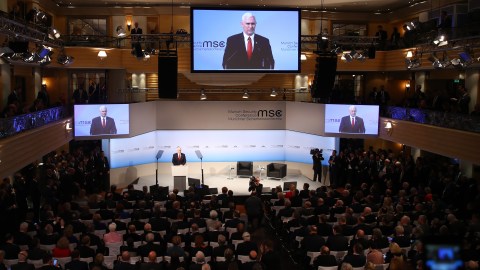
A watershed moment for Europe. The February 2017 Munich Security Conference was a watershed moment for the trans-Atlantic alliance, observes Constanze Stelzenmüller. But looking back, it will be defined as the moment in which the parties fundamentally reassessed not just the division of their responsibilities, but the reliability of their allies.
Pay no attention to the president? When Vice President Mike Pence, Secretary of Defense James Mattis, and Secretary of State Rex Tillerson arrived in Europe for various high-level meetings, they brought with them a clear message, observes Jeremy Shapiro: pay no attention to the president of the United States. But only the president can truly make foreign policy, he reminds readers.
Expecting the unexpected in 2017. Federal Executive Fellows Adrienne Janetti and Maria Langan-Riekhof write that with the beginning of a new year, it is important to explore plausible if not probable events that could be on the horizon, particularly for the tumultuous Middle East and South Asia where societies remain extremely fragile and susceptible to sudden changes.
|