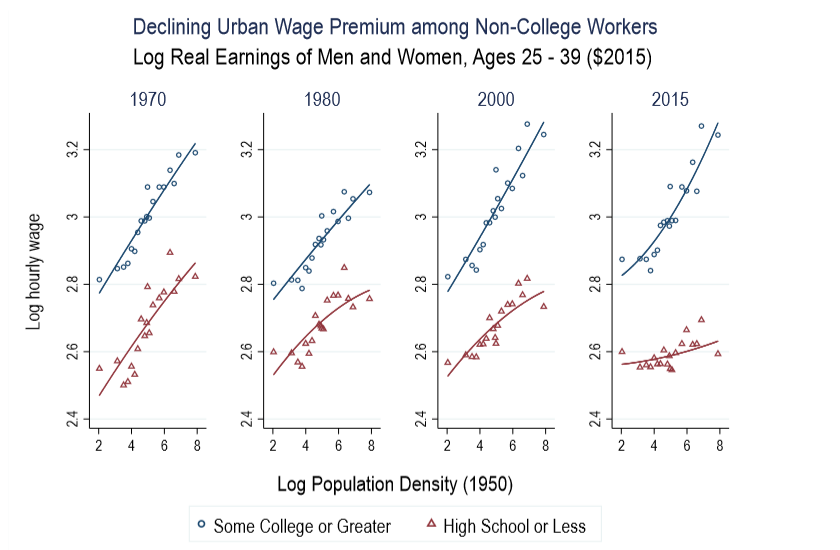
This week in Class Notes: Sesame Street improved educational and labor market outcomes for preschool-age children. Companies that commit to easing employees’ caregiving burden may gain competitive advantage, and robots reduce employment and wages more than immigrants do. In fact, our chart of the week shows how robots reduced wages for urban mid-skilled non-college workers, starting from the 1980s. Emmanuel Saez and Gabriel Zucman opine on curtailing inequality through taxes. Our Spotlight on Education features an essay detailing the unforeseen outcomes of valedictorians 13 years after graduating high school in Boston. Finally, check out our latest report on boosting tax credits.
Did "Sesame Street" improve educational and labor market outcomes for preschool-age children? Melissa Kearney and Phillip Levine find evidence that the show improved school performance, particularly for boys. The authors exploit county-level variation in viewership as a result of technological constraints when the show was introduced in 1969. Specifically, they examine whether the educational outcomes among birth cohorts who were age six and under in 1969, and who lived in locations where broadcast reception for the show was good, showed better outcomes than older cohorts and those who lived in locations with limited broadcast reception. Improved relative outcomes for the former group strongly suggests a causal impact of exposure to "Sesame Street."
Employees are struggling to balance the responsibilities of work and caregiving, so there may be gains for companies that provide more help on the caring front. Three in four employees report having some type of childcare or eldercare responsibility (side note: this is one reason that "time" is one of the key work themes for our initiative; watch this space). According to Joseph Fuller and Manjari Raman, companies underestimate the hidden costs of employee caregiving and the extent to which it affects employee performance. In what they label a “caring company,” managers will take the following steps: identifying the magnitude and nature of a company’s workforce’s care needs; evaluating the relevance of its existing benefits package, and exploring the plausibility of expanding the benefits or developing customized solutions; and capturing the returns associated with boosting employee retention and productivity.
The robots are coming! How will they affect the future of work in the United States? George Borjas and Richard Freeman evaluate the impact of automation on labor outcomes and show that robots reduced employment and wages. The researchers treat the exponential growth in the number of robots in the last two decades as a supply shock to the U.S. labor market, and compare its effects to an influx of immigrants during the same period. An additional robot reduces employment and wages by roughly as much as an additional three workers entering the labor market. The authors conclude that the robot supply shock in the last two decades has been too modest to disrupt the labor market. But estimates show that robots could disrupt job markets in the coming decades (which is why we need to help the middle class get ready).
In the 1970s, Americans who didn’t go to college could nonetheless move to cities and get good jobs in manufacturing or office work. A decade later, wages for mid-skilled urban workers declined as their jobs began to disappear, according to research by David Autor (summarized in his AEA lecture, and summarized by Noah Smith in Bloomberg). The kinds of tasks that were productive for mid-skilled non-college workers have largely been automated. Wages for mid-skilled jobs have equalized between urban and rural areas. As a result, a major path to middle-class prosperity has been severed because mid-skilled workers no longer get a pay increase by moving to cities.
“Tolerating extreme inequality means accepting that it’s not a gross policy failure, not a serious danger to our democratic and meritocratic ideals—but that it’s fair and just and natural. It produces its own self-justifying ideology. It vindicates the ‘winners’ of world markets. But vindicated winners, sure of their own legitimacy, seldom share much of their ‘just deserts’ with the rest of society,” write Emmanuel Saez and Gabriel Zucman in The New York Times.
This week’s spotlight is on education, and features an essay from The Boston Globe's Valedictorians Project. The project followed Boston’s 93 valedictorians from the classes of 2005-2007 to find out how their lives turned out more than a decade later. "On paper, no students in Boston are better positioned for upward mobility than its valedictorians… But in an era when social mobility is in sharp decline, many of Boston’s valedictorians struggled after high school, their vaulting ambitions running headlong into a thicket of real-world obstacles—obstacles their wealthier, often white counterparts in the suburbs much more rarely encounter. Theirs are stories of inequality not just in income, but in opportunity," report Malcom Gay and Eric Moskowitz.
“Lots of plans to boost tax credits: Which is best?” Isabel Sawhill and Christopher Pulliam examine the ability of three tax credit proposals to reduce poverty, make work pay, and support children. They conclude that the earned income tax credit (EITC) best accomplishes the desired goals, but there is room for improvement.
Also, don’t forget our joint event with AEI featuring new Harvard President Lawrence Bacow and an expert panel: Register to attend.
Thanks for reading! Please forward to colleagues or friend who might be interested in hearing from us.
The Brookings Institution, 1775 Massachusetts Ave NW, Washington, DC, 20036