Not rendering correctly? View this email as a web page here.


February 8, 2018

Brookings on Twitter Brookings on Facebook

Dear friends and colleagues,

We have entered a new phase in international affairs. The brief post-Cold War moment characterized by American dominance is receding, and we now confront a period defined by heightened great power competition. The choices the United States and other key powers now make will reverberate throughout this new geopolitical landscape, leading us either to a situation of tense stability or to a more dramatic, and probably violent, re-ordering of international relations.

Brookings Foreign Policy experts have unparalleled expertise on the key regions and dynamics of this changing landscape. From China and North Asia, to South and Southeast Asia and the Middle East, to Russia and Europe, Brookings scholars are delving deep into the changing strategies of our allies, competitors, and challengers, and examining the implications for U.S. grand strategy as well as global trade—topics that will define this era.

I’m excited to launch a major new initiative called The New Geopolitics: to conduct in-depth research on the forces at play, and offer ideas and strategies to guide policymakers on how they should act to secure peace and prosperity in this turbulent period.

Stay tuned for much more to come, and for additional information, visit The New Geopolitics homepage.

Sincerely,

Bruce Jones
Vice President and Director
Foreign Policy at Brookings

Watch The video


Watch Brookings experts explain the landscape of the new geopolitics, highlighting the countries that are likely to present the greatest strategic challenges to the United States in the years to come and arguing for greater U.S. engagement around the world.

Featured Content

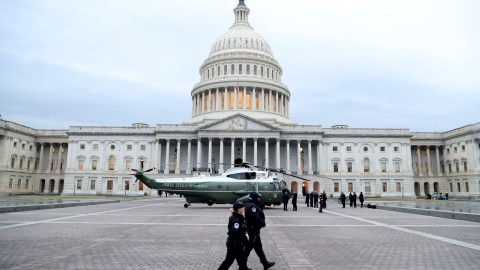
A military helicopter lands at the U.S. Capitol in Washington, DC, U.S., January 20, 2017. In today's inauguration ceremony Donald J. Trump becomes the 45th president of the United States. REUTERS/Rob Carr/Pool - RTSWGJK

Asia

The future of U.S.-China relations. Seven experts offer their views on how the United States and China should navigate their relationship amid a rapidly changing geopolitical environment.

The North Korean nuclear crisis. In a Intersections podcast, Ryan Hass, Jung Pak, and Bruce Jones discuss why Kim Jong-un is pursuing a high-risk nuclear weapons program and how the United States should pursue a denuclearized Korean Peninsula.

U.S. trade policy in Asia. In her latest book, Mireya Solís examines how countries can craft international trade policies that meet their economic needs while also satisfying domestic public demands.

Europe

Normal is over. U.S.-Europe relations have not normalized under President Trump, argues Constanze Stelzenmüller. Indeed, deep undercurrents on both sides of the Atlantic could open a lasting rift in the alliance.

Eastern European security. After decades of NATO expansion, Michael O'Hanlon presents a bold new proposal to boost Eastern European security.

Europe after America. Thomas Wright contends in a recent paper and podcast episode that Washington should return to a policy of deeper engagement in trans-Atlantic affairs.

Middle East

U.S.-Saudi relations. In a recent book, Bruce Riedel offers an insider's account of the often-fraught relationship between Washington and Riyadh.

U.S. policy toward Iran. Amid serious questions about the future viability of the Iran nuclear deal, Suzanne Maloney says walking away from the agreement in an environment of deep regional instability would be precisely the wrong step for the United States.

Extremism and regional instability. With ISIS apparently facing military defeat in Iraq and Syria, Suzanne Maloney and Michael O'Hanlon outline a strategy to begin restoring a modicum of stability in the Middle East.