Along the Buffalo Bayou waterway west of downtown Houston, the 160-acre Buffalo Bayou Park has trails, play areas, a dog park, pavilions, and gathering spaces for residents to enjoy and build community. However, other areas near this vital natural asset—particularly the majority-Black and Latino or Hispanic Greater East End and Fifth Ward neighborhoods—have not seen the same level of attention. In this Placemaking Postcard, Karen Farber of the Buffalo Bayou Partnership discusses how her organization is leading a multiyear effort to better connect these amenities to neighborhoods with long histories of disinvestment.
Thursday, February 23, 2023 10:00 AM – 11:00 AM EST
Next week, Jennifer S. Vey will moderate a discussion exploring music’s role in placemaking, focusing particularly on Huntsville, Ala., where a wide-ranging audit led to the opening of a world-class amphitheater, and Tulsa, Okla., where a community development initiative, Fire in Little Africa, has received global acclaim. Shain Shapiro of the Center for Music Ecosystems will join speakers representing both cities to discuss how creating robust music ecosystems can transform and improve cities in a myriad of ways.
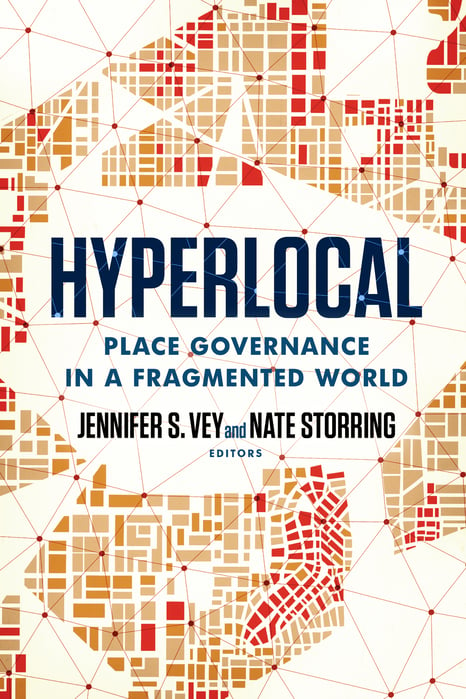
Edited by Jennifer S. Vey and Nate Storring, “Hyperlocal: Place Governance in a Fragmented World” explores the role of place governance in today’s increasingly fragmented and inequitable economic landscape. Its eight chapters discuss how, why, and for whom place governance matters, and highlight practices and models for creating more connected, vibrant, and inclusive communities.
📅 Mark your calendars.On Thursday, March 9 at 2:00 PM EST, Brookings will host a webinar to discuss themes from the books "Hyperlocal" and "Co-Cities." Speakers will examine how policies and practices from the U.S. and around the globe are positioning communities as key actors in the production, delivery, and management of urban assets and resources. Stay tuned for information on how to register.
Want to be featured on a Brookings podcast?
Do you have a story of positive change in rural America? If so, we encourage you to email our colleague Tony Pipa at globalmedia@brookings.edu. Tony is a senior fellow at the Brookings Center for Sustainable Development, and his Reimagine Rural podcast explores how public investment in rural people and places can lead to increased and equitable prosperity. Reach out and you may be featured on an upcoming episode!
What we’re reading
A new blueprint for transportation decarbonization. On January 10, the Biden-Harris administration announced a landmark blueprint for reducing greenhouse gas emissions from the transportation sector by 2050. The blueprint has significant implications for place-based investment, including reforms to street design, zoning, and transit-oriented development that can help create more connected communities. This news comes as Boston University’s Initiative on Cities released a major report detailing U.S. mayors’ views on climate change. Of the 118 mayors surveyed, 97% say they are worried about the effects climate change will have on their cities—a surprising finding that transcends partisanship. Mayors cited regulatory powers over zoning and building codes as their most powerful tool to tackle climate change, and 74% support replacing city-owned vehicles with more fuel-efficient versions before their lifetime ends. While many see opportunity for action through the transportation sector, most mayors are hesitant to enact policies that would hinder individual behavior, such as restrictions on gas stoves.
Ensuring equity in micromobility. From 2020 to 2021, the number of e-bike sales nearly doubled, while also outpacing sales of electric cars and trucks. This trend has raised questions about the future of transportation and the need for new infrastructure to support micromobility. Many cities have considered how to make equity a priority in their micromobility programs; a study from the University of Oregon found that 62% of micromobility programs across the U.S. documented equity requirements, but many failed to establish goals or measure impact. To improve equity, experts suggest that cities collect data linked to program goals, ensure even placement of e-bikes and e-scooters throughout neighborhoods, and require private micromobility companies to partner with community-based organizations. One locality leading the way on this issue is Ossining, N.Y., a small town located on the Hudson River; officials there are building the infrastructure to support an e-bike sharing system for residents, with the goal of improving viable transportation for low-income populations. Last year, New York Governor Kathy Hochul granted the program $7 million as part of a statewide initiative to enhance clean transportation, improve mobility options, and reduce harmful emissions.
🚗 Did you know? A Brookings analysis of 2018 geolocation data from six metropolitan areas found that people travel over 7 miles on average for every trip they take, though distances vary widely across both metro areas and neighborhoods. Given these patterns, it’s not surprising that, according to the Environmental Protection Agency, the transportation sector—including cars, trucks, trains, ships, airplanes, and other vehicles—account for 27% of total U.S. greenhouse gas emissions, the largest share of emissions among any single economic sector.