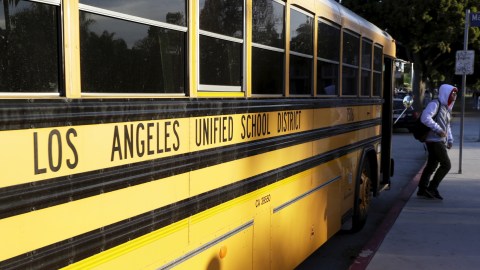
Since 2000, about 40 communities across the country have successfully broken away from their school districts to form their own education systems. Richard Reeves and Nathan Joo assess why schools are seceding and at what cost.
New research finds that cash transfers to families in the lowest income distribution and anti-poverty programs increase the likelihood of a child’s civic participation in adulthood.
While incomes at the very top of the distribution have increased over the past half-century, those of the middle class have remained stagnant. Eleanor Krause and Isabel Sawhill highlight the economic trends that have Brookings experts worried about the future of America’s middle class.
What accounts for gaps in student loan default, and what happens after. Nearly 50 percent of black undergraduate borrowers entering college in 2004 defaulted on their student loans within 12 years of entry—more than double the rate for white students. What's to blame for this stark divide?
Labor Policy
Meeting the automation challenge to the middle class. While it won’t decrease jobs, automation could lead to even greater separation between the American upper and middle classes. Robert Litan looks at how to address these concerns and ensure the growth brought by automation is broadly shared.
About THE Center on Children and Families Newsletter
A periodic update of new research on poverty, inequality, and opportunity from the Center on Children and Families at Brookings.